
Venice, California: A Century of Canals, Culture, and Change


Before Venice
At high tide the marsh swelled with seawater, glittering under the sun and carrying gulls on its surface. When the tide receded it left behind mudflats patterned with the tracks of crabs and mussels, while herons stalked the reeds in search of fish. The dunes nearby shifted constantly in the wind. At dusk, foxes padded across them and crickets rasped in the grass.
This was the Ballona wetlands, a vast expanse where freshwater from inland streams mingled with the Pacific. It was not a wasteland, though later settlers would call it that. It was a mosaic of lagoons, meadows, and tidal pools, shaped by tide and season. Where Lincoln Boulevard now runs, there was only a dirt trail pressed into reeds. Where Pacific Avenue cuts straight to the ocean, there were thickets of willow bending in the salt breeze.
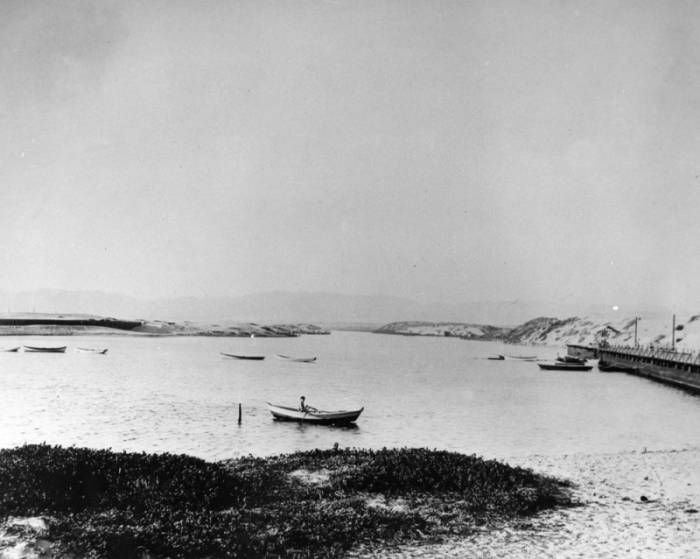
The people who lived here were the Tongva. For thousands of years, villages such as Sa’angna and Guashna stood along the edges of the lagoon. Families launched canoes made of tule reeds, gliding across the water to fish or gather clams. Hunters tracked deer in the meadows. Children played near houses framed with willow poles and covered in reeds. To the Tongva, this landscape was not wilderness. It was home, a place cultivated and understood, each channel and dune tied to memory and ceremony.
That continuity was broken in the late eighteenth century. In 1769 the Portolá expedition claimed this land for Spain. Within two years Mission San Gabriel Arcángel was established inland, pulling the Tongva into its orbit. The priests believed they were saving souls by gathering Indigenous people into agricultural colonies. But for the Tongva it was upheaval. Families were separated, languages and rituals forbidden, and cattle trampled meadows where reeds once grew. European crops spread across the wetlands, and foreign diseases swept through villages with devastating force.
Under Mexican rule in the early 1800s, the land was divided into ranchos. Ballona Rancho, granted to the Machado and Talamantes families, stretched across what is now Venice, Marina del Rey, and Culver City. Adobe ranch houses rose, and cattle grazed where herons had once hunted freely. When the United States annexed California in 1848, many Californio families lost their ranchos through taxes, debts, or lawsuits, and the land fragmented.
By the late nineteenth century, the wetlands still shimmered with herons and reeds, but the people who had tended them for generations were pushed to the margins of a city expanding west. To developers, the marsh looked empty. To speculators, it was wasted ground waiting to be remade.
A City Dreamed into Existence
Into this landscape of reeds and tidal pools came a man who saw something entirely different. Where most saw only mud and mosquitoes, he pictured canals, bridges, and music drifting over water. He saw families strolling beneath colonnades, gondoliers rowing in the California sun, and a city that shimmered with both beauty and order.
His name was Abbot Kinney.

Kinney was born in New Jersey in 1850, into a family that afforded him privilege and education. But he was restless by nature. At sixteen he was already wandering Europe, sketchbook in hand, noting the geometry of Parisian boulevards and the elegance of Venice’s waterways. He filled those pages with drawings and reflections that were more than travel souvenirs. They were early outlines of a dream, plans he would one day try to build into reality.
When he returned to the United States, Kinney built a fortune in tobacco distribution. By his thirties he was wealthy enough to live in leisure, but he was no idle tycoon. His interests were wide and sometimes eccentric, and he believed deeply in the ability of an environment to shape human character. Unlike his peers who poured their money into railroads or factories, Kinney invested in ideas: parks, promenades, libraries, and public spaces designed not just for profit, but for civic uplift.
He was also a conservationist, long before the word had currency. In the 1880s he planted vast groves of eucalyptus in Santa Monica, experimenting with reforestation on a scale unheard of in California at the time. He argued that cities needed trees, green belts, and gathering places, a vision at odds with an era bent on unrestrained development. Though some experiments failed, they revealed a man convinced that design and ecology belonged together.

California drew him with its promise of open space and light. Its climate was marketed as a cure for illness, and its unshaped landscapes seemed to invite grand plans. Kinney saw it as a canvas where his European sketches could become reality.

It is not hard to imagine him standing at the edge of Ballona Lagoon, notebook in hand, looking out over the reeds that swayed in the ocean wind. The air smelled of salt and brine, the cry of gulls echoed across the water, and the horizon was wide and empty. Others saw a wasteland. Kinney saw gondolas gliding through narrow waterways, arched bridges catching the light, and colonnades rising in clean lines against the sky. He saw fireworks bursting over the Pacific and lanterns glowing in the night. He saw, in the marsh before him, a city that did not yet exist but already gleamed in his mind.
It was to be nothing less than a “Venice of America.”

The Birth of the Canals
By 1904 the marshland was no longer quiet. The sound of dredges rumbled across the lagoon as iron claws tore channels through mud and reeds. Horses strained against wagons piled with wet earth. Carpenters hammered footbridges from freshly milled lumber, and the smell of tar from wooden pilings carried on the wind. The wetlands that had once echoed with birdsong were now a worksite, loud with saws, shouting, and the clatter of shovels.
Kinney needed hands, and he drew them from across Los Angeles. He hired Black workers in large numbers, offering steady wages in an era when few other opportunities were open. To house them he steered families toward the inland tracts that would become Oakwood, one of the only neighborhoods on the Westside where African Americans could purchase property. What began as labor camps soon grew into a community of churches, stores, and homes that would define Venice’s cultural heart for generations.

Immigrants filled the ranks as well. Mexican laborers hauled timbers and stone. Italian stonemasons shaped foundations and bridges. To give his city an air of authenticity, Kinney even imported gondoliers from Venice itself, their striped shirts and songs of home floating across the half-finished canals. By dusk, when the day’s work ended, voices in English, Spanish, and Italian mingled in the boarding houses and camps that rose on the edges of the site.
Within a year, sixteen miles of canals stretched across what had been marsh. Fresh paint gleamed on the bridges, and tidy parcels of land lined the waterways, ready for buyers. Along the oceanfront, a massive pier bristled with roller coasters, fun houses, and arcades. The smell of sawdust still lingered when Kinney declared the city ready for its grand opening.

On July 4, 1905, twenty thousand people arrived by trolley and wagon. The new boardwalk trembled under their weight. Men in straw boaters tipped their hats against the glare. Women raised parasols like blossoms above the crowd. Children clutched balloons and begged for lemon ice. The air smelled of salt, roasted peanuts, and fresh paint.
A brass band struck up near the lagoon as gondolas glided under arched bridges, oars cutting the water in steady rhythm. Vendors shouted over the din, selling popcorn and sweets. The pier rattled with the shrieks of roller coasters, the boards quivering under the thunder of feet.

As the sun fell, lanterns glowed along the colonnades. Fireworks burst over the Pacific, scattering sparks across the water. For a few dazzling hours Venice of America existed exactly as Kinney had dreamed. A city conjured up from mud and vision, equal parts carnival and utopia.
But even in its first hour the fault line was clear. Kinney wanted symphonies and libraries. The crowds mostly came for thrills: rides and sideshows. From the beginning, Venice’s heart beat to the rhythm of the midway.
From World War I to the Roaring Twenties
In the years after opening day, Venice settled into its rhythm. Trolleys rattled along electric lines, carrying crowds from downtown Los Angeles to the beach. On weekends, the air filled with the sound of brass bands and the shrieks of children as roller coasters plunged over the pier. Families rented bungalows along the canals for summer, and boardwalk arcades thrummed with games of chance.
But the first cracks appeared sooner than anyone expected. When the United States entered World War I in 1917, the flow of visitors slowed. Young men left for Europe, and many of the jobs that had fed the tourist economy faltered. The pier dimmed, its rides less crowded, the laughter thinner.

Abbot Kinney lived long enough to watch the early signs of change. In his final years he was in declining health, though still dreaming of civic improvement. He died in 1920, leaving behind a city already struggling to reconcile his ideals with reality. Without his guidance, control of Venice shifted to managers and investors whose eyes were fixed more on profit than on culture. His death marked the end of Venice’s first chapter, and the beginning of a long tug-of-war over what the neighborhood would become.
Meanwhile, the world outside was transforming. Cars were no longer curiosities but necessities. Model Ts chugged through Los Angeles in growing numbers, pressing city planners to favor roads over canals. Streetcars still brought Angelenos west, the red cars of the Pacific Electric Railway running in shining lines across the basin, but automobiles were beginning to win the future.
Venice itself was coalescing into the neighborhoods we recognize today. The Canals formed one pocket, still picturesque but already expensive to maintain. Oakwood was expanding inland, home to Black workers who had settled there when few other Westside tracts were open to them. Windward Circle, with its arcades and shops, served as the commercial hub. And just beyond the carnival atmosphere, modest cottages spread into what would become Penmar and East Venice, quieter and more residential.

Social life, too, was shifting. Prohibition arrived in 1920, and Venice adapted quickly. Behind the colonnades and down back alleys, unmarked doors opened into speakeasies where jazz bands played to rooms heavy with smoke. Whiskey flowed into teacups, and the pier that had once been a family playground now doubled as a haven for nightlife. At the same time, women in California had won the right to vote in 1911, nearly a decade before the 19th Amendment extended suffrage nationally. In Venice, that change echoed in local politics, as women began to take visible roles in civic debates, from school boards to neighborhood associations.

For much of the 1920s, the boardwalk still pulsed with energy. Tourists filled trolley cars on weekends, lanterns glowed at night, and the pier’s midway buzzed with barkers and dancers. Newspapers called it “the Coney Island of the Pacific.” Yet under the surface, the foundation was already weakening. The canals were too costly, the rides too fragile, the city too young to withstand the pressures bearing down from Los Angeles.
When annexation came in 1926, Venice lost its independence and was absorbed into the growing metropolis. To city officials downtown, the canals were not romantic but inefficient. Within a few years dredges returned, not to carve waterways but to fill them. Streets were paved where gondolas had once drifted. Cars had won.
Venice entered the twilight of its carnival years with both brilliance and fragility. The brass bands still played, the roller coasters still rattled, the speakeasies still hummed, but the light was dimming.
The Depression and World War II
By the early 1930s the midway lights were dim. The Great Depression had arrived, and Venice felt the shock. Families had less to spend on amusements, and the pier’s rides closed one by one. The Ferris wheel stopped turning, dance halls went silent, and the barkers who once shouted above the noise now stood idle. Boarded-up storefronts stared blankly onto Windward Circle, their painted signs fading in the salt air.
Another blow had already fallen a few years earlier. After annexation in 1926, Los Angeles set about reshaping Venice to fit its car-centered future. Between 1928 and 1929, most of the city’s sixteen miles of canals were filled in and paved over. Streets now ran where gondolas had once glided, and only a fraction of the waterways survived. Those that remained were too narrow or inconvenient to bury, and by the 1930s they were neglected, their waters stagnant and sour. Kinney’s dream was receding into memory even before the Depression tightened its grip.

The economic collapse weighed heavily on residents. Homeowners lost cottages to back taxes, and lots that once sold for thousands changed hands for only a few hundred. Reporters began to call Venice “the Slum by the Sea,” a place where glamour had collapsed into decay. The smell of brine and popcorn that had once carried across the boardwalk was replaced by dust and mildew.
Yet people continued to live and build lives here. Oakwood in particular grew stronger as a community. Black families, originally drawn by Kinney’s labor jobs decades earlier, held tight to their neighborhood, founding churches, corner stores, and civic clubs. For many years it was one of the only places in Los Angeles where they could own property, and the sense of belonging ran deep.
Then came another war.
When World War II swept across the globe, Los Angeles transformed almost overnight into an arsenal of democracy. Shipyards in San Pedro, aircraft factories in Santa Monica and Culver City, and military installations up and down the coast demanded workers by the thousands. Venice, with its cheap housing and proximity to jobs, filled quickly. Defense workers rented bungalows along streets that had once been summer cottages. The surviving canals, long neglected, became home to families drawn by opportunity rather than scenery.
Oakwood expanded further, as African American workers from across the country came west for wartime jobs and found one of the few neighborhoods that would welcome them. Churches flourished, barbershops and small businesses opened, and Oakwood solidified its reputation as the heart of Black life on the Westside.
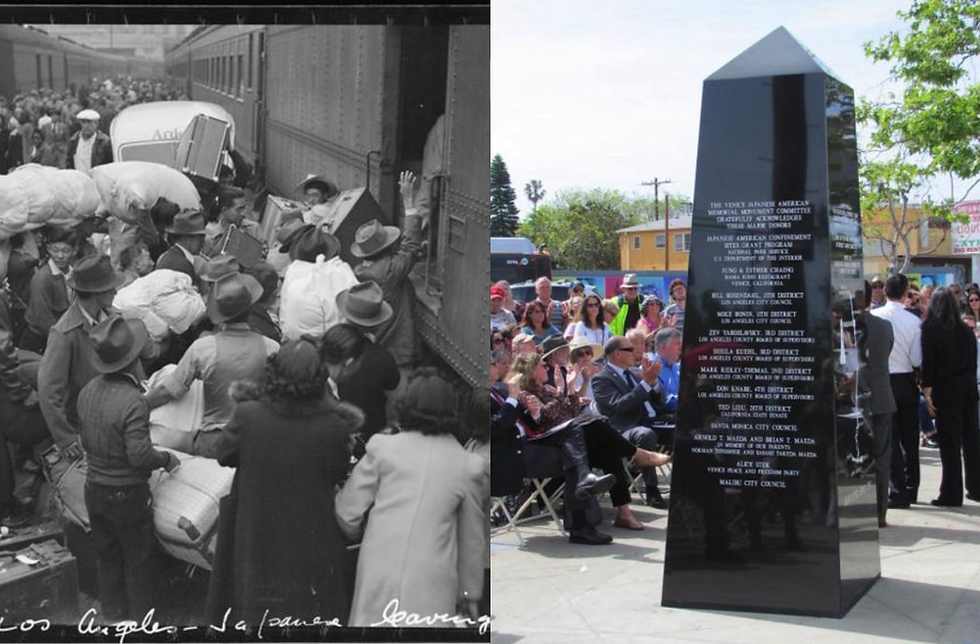
Venice also had a thriving Japanese American community in these years: gardeners, fishermen, and small business owners who made their living from the land and sea. In 1942, Executive Order 9066 forced them into internment camps. Families were uprooted, homes and shops lost, and a layer of the neighborhood’s fabric was torn away. Their absence was felt in the silence of shuttered businesses and the disappearance of familiar faces from the streets.
At the same time, immigration from Mexico and Central America was reshaping the community. Many new arrivals took jobs in factories, service, and construction, renting modest homes in East Venice or sharing space near the boardwalk. Spanish-language music and Catholic festivals began to add their own rhythm to the neighborhood.
By war’s end, Venice looked weary. The pier had been neglected, some rides dismantled for scrap, and the colonnades weathered into gray. Yet the neighborhood was dense with life. Returning GIs bought small tract homes in Penmar or rented bungalows near Rose Avenue. Families filled modest cottages with children and boarders. On summer nights, the air smelled of tortillas frying, church bells ringing, and laundry soap carried on the breeze.
Venice was no longer a carnival city. It was a working-class town, patched together by defense workers, immigrants, returning soldiers, and families determined to make something of what remained.
Beats and Bohemia (1950s–1960s)
On a summer evening in the 1950s, Venice carried the smell of salt, tar, and fried food from corner diners. The pier was gone, dismantled plank by plank, and the canals sat brackish and half forgotten. Yet life hummed through the cracks. Kids played stickball in alleys, families sat on porches in the cooling air, and a saxophone line drifted faintly from an open window. The city that once promised gondolas and colonnades had become a patchwork of neighborhoods, stitched together by affordability and grit.
The Canals, now shabby and neglected, attracted artists who saw poetry in their decay. Windward Circle and Ocean Front Walk remained the commercial hub, filled with storefronts, hustlers, and the first bohemian galleries. Oakwood thrived as a Black cultural center, anchored by churches and community halls. Penmar and East Venice filled with modest tract homes bought by returning GIs, teachers, and city workers. Rose Avenue’s industrial sheds became cheap havens for painters and carpenters, while West Washington Boulevard, later renamed Abbot Kinney, was still lined with liquor stores, repair shops, and corner markets. Venice was not only a place of artists and musicians. It was also a neighborhood of families, shopkeepers, and laborers who made ordinary lives in an extraordinary setting.
The Venice West Café became the center of gravity. Its bare floors and mismatched chairs might have looked unimpressive by day, but at night it glowed with a charged intensity. Poets stood in the smoke-thick air and read to crowds who snapped in response. Stuart Z. Perkoff, often called Venice’s own Beat laureate, read here alongside visiting voices from San Francisco and New York. Charles Bukowski appeared occasionally, his gravelly verses fitting the room’s unvarnished character. Lawrence Lipton captured the spirit of it all in his 1959 book The Holy Barbarians, which fixed Venice in the national imagination as a West Coast counterpart to Greenwich Village.

Outside the café, murals began to bloom across stucco walls, a cultural gesture that would come to define the city. Inspired both by the improvisational freedom of the Beats and the growing influence of Chicano muralists from East Los Angeles, Venice’s buildings became open canvases. Color spilled across weathered surfaces, transforming decay into public art.
Music threaded through the neighborhood as well. Folk singers performed on the boardwalk, guitars competing with the crash of waves. Jazz played in Oakwood’s living rooms and clubs. By the mid-1960s, Jim Morrison and The Doors were rehearsing in a small beachfront apartment, their sound drifting out to passersby. Venice became a laboratory for voices that did not fit comfortably anywhere else.
By the late 1960s, a younger generation added its own presence. Long-haired wanderers set up on the boardwalk, experimenting with new forms of art, music, and community. Venice never became a full-scale hippie enclave like San Francisco, but its openness and beachside informality attracted those who were searching for alternatives to mainstream life.
The neighborhood was also swept into the unrest of the time. Civil rights activism resonated strongly in Oakwood, where residents organized against discrimination and police harassment. Draft notices arrived in homes across Penmar and East Venice, and the Vietnam War cast a long shadow. Students and artists marched against it, gathering on boulevards and beaches, watched by police who distrusted the community. Venice was not quiet. It was alive with the same tensions and contradictions playing out across the country, war and protest, repression and creativity, all set against the ocean and the murals that multiplied on its walls.

By the close of the 1960s, Venice was poor, sometimes violent, but deeply alive. It was a community of families and workers living alongside poets, musicians, and visionaries, all of them making something out of neglect. What had once been an amusement park had become a crucible of rebellion and creation.
Dogtown and the Z-Boys (1970s)
By the 1970s, Venice felt like a city left behind. The arcades of Windward Circle stood chipped and faded, the sidewalks cracked and patched with weeds. Empty lots collected trash and windblown sand. The canals that survived the city’s road-building were stagnant and foul, lined with slumping bungalows. Police patrolled irregularly, and the boardwalk carried an edge that kept many Angelenos away. To outsiders Venice was dangerous, but to those who lived here it was simply home.
The neighborhoods each told their own version of this decline. Oakwood faced mounting poverty and the early rise of gang activity, even as families worked to hold on to the community they had built over decades. Penmar and East Venice stayed quieter, with modest homes filled by families of teachers, postal workers, and city employees, but they too felt the city’s neglect. The Canals were cheap enough to house a mix of eccentrics, artists, and working-class renters who tolerated their crumbling charm. Windward and the boardwalk remained a marketplace, but more for hustlers, fortune tellers, and street performers than for the steady businesses of the past. Rose Avenue, still lined with industrial buildings, became a home for scrappy artists and craftspeople making do with what they could afford.
It was in this environment that a new culture was born. At the ruins of Pacific Ocean Park, local kids surfed waves shaped by the twisted wreckage of the pier. The break was treacherous, avoided by outsiders, but it forced a style that was low, fast, and aggressive. These teenagers learned to ride with a fluid recklessness, carving arcs on waves that punished hesitation.

When a drought in 1976 left swimming pools drained across Los Angeles, they carried that style inland. They scaled fences and dropped into empty basins, turning suburban backyards into arenas. The sound of urethane wheels screeched against plaster, dust and chlorine filled the air, and spectators leaned over fences to watch. Out of trespass and improvisation came a new language of movement.
The Zephyr Skate Team, known as the Z-Boys, embodied it. They came out of the Zephyr surf shop on Main Street, sponsored by shop owner Jeff Ho and shaper Skip Engblom. Photographers captured them crouched low on boards, hands dragging across concrete, bodies twisting parallel to the ground. What looked reckless to outsiders was, to them, simply surfing translated to land. Their style exploded across the skateboarding world, and suddenly the forgotten streets of Venice and Santa Monica were the birthplace of a global youth culture.
The rebellion did not stop with skateboards. Punk bands set up in warehouses, their music rattling through corrugated walls. Graffiti appeared on brick buildings in block letters that shouted into the night. The boardwalk became a stage, where kids performed for tourists, drummers set up circles on the sand, and hustlers turned survival into theater. Venice was broke and sometimes violent, but it pulsed with a creative defiance that made it magnetic.
For the outside world, Dogtown became legend. For those who lived it, it was just life: cracked sidewalks, cheap rent, and the thrill of carving something beautiful out of ruin.
Venice in the Crosshairs (1980s–1990s)
In the 1980s, Venice wore two faces. On one side it was vibrant, filled with murals, music, and boardwalk performers. On the other, it was feared, a place whispered about in Los Angeles for its crime, poverty, and police tension. The nickname “Slum by the Sea” returned, but it carried a new meaning. Venice was not collapsing quietly. It was alive, loud, and often dangerous.
Each neighborhood carried a share of the struggle. Oakwood, still the heart of Black Venice, was battered by the rise of gangs and the crack epidemic. Families who had owned homes for generations now contended with violence on their streets. Yet Oakwood was also a site of resilience. Churches doubled down as anchors of community life, and activists organized against redlining and police abuses.

The Canals, long neglected, housed a mix of artists, eccentrics, and renters who lived among decaying bridges and polluted water. Windward Circle and Ocean Front Walk, Venice’s commercial core, were dense with street performers, fortune tellers, spray-paint artists, and hustlers. The Rose Corridor remained industrial but was increasingly adopted by artists who needed large, affordable spaces. Penmar and East Venice were the quieter residential heart, filled with teachers, city employees, and small-business owners, yet they too felt the stigma of living in a city marked by violence. Abbot Kinney Boulevard, still West Washington until 1991, was a working-class strip of liquor stores, corner markets, and auto shops.
Amid the turmoil, Venice’s art scene erupted. Murals covered block after block, filling walls with color and politics. Some were community projects, others the work of individual visionaries, but together they created one of the most concentrated mural landscapes in America. Poetry readings continued, punk shows rattled warehouses, and performance artists turned the boardwalk into a laboratory. The creative energy was raw, often confrontational, but impossible to ignore.

The boardwalk itself was theater. Breakdancers spun on cardboard, spray-paint artists built murals in real time, fortune tellers laid out cards, and drum circles pounded until sunset. Tourists came in equal parts fascinated and wary. Families wandered through by day, but at night the edges sharpened. Police cruisers rolled slowly down alleys, their relationship with the community tense and often violent. LAPD raids in Oakwood became infamous, and mistrust between officers and residents ran deep.
By the 1990s, a shift was underway. Alongside the danger came a surge of reinvention. Artists and gallerists began speaking of a “Venice Renaissance.” Collectives opened experimental theaters and performance spaces in warehouses. Galleries showcased bold new work, some political, some surreal, all shaped by the tension of the neighborhood. It was not yet gentrification, but it was a foreshadowing. Creativity was planting the seeds of a very different future.
Venice in these decades was a contradiction. It could feel exhilarating or frightening, depending on where you stood and when the sun went down. To the outside world it was chaos. To those who lived there, it was both survival and expression, danger and art braided together in one turbulent, unforgettable place.
Gentrification and Tech (2000s–2010s)
In the early 2000s, Venice still wore its age openly. Murals flaked in the salt air. The boardwalk hummed with fortune tellers, drummers, and spray-paint artists. Abbot Kinney Boulevard was beginning to change, but it had not yet become a destination. You could still hear the whine of an impact wrench from a corner garage while a gallery two doors down swept its stoop for an evening opening. The canals, dredged and cleaned in the 1990s, glimmered again at high tide, their footbridges reflected in water that no longer smelled of neglect.

The shift started quietly. Boutiques and cafés appeared where liquor stores and repair shops had been. Artists still rented studios, but they now shared the street with pastry cases and espresso machines. By the mid-2000s, Wi-Fi signs hung in café windows, and a new kind of patron settled in with a laptop and a long espresso. Digital creatives and freelancers found the neighborhood’s informality a perfect office. Early social media arrived, and with it a habit of turning daily life into a stream of images. Photographers with DSLRs framed skateboarders against the sea. Style blogs shot outfits on Abbot Kinney’s sidewalks. Venice became a backdrop as much as a place.
Then came the smartphones. After 2007, the way the neighborhood was seen and shared changed quickly. By 2010, people filmed drum circles for tiny screens and posted snapshots of murals to new apps that organized the world into squares. Venice’s eccentricities, once local, now reached everywhere at once. A painted wall could travel the world in an afternoon. A café latte could become part of a brand. The neighborhood learned what it felt like to be both lived in and performed.
Corporate tech followed the image. In 2011, Google moved into the binocular building on Main Street, a playful landmark that suddenly meant something new. Startups rented space in former warehouses along Rose and Electric. Venice gained coworking lofts and clean white storefronts that sold well-made things at careful prices. Snapchat opened offices near the beach a few years later, and the presence of young employees with badges and scooters became part of the street’s rhythm. The term Silicon Beach stopped sounding like a joke and started to feel like a forecast.
Housing moved with the money. On the canals, modest bungalows were renovated into glass and cedar. Sales crept into numbers that once belonged only to the hills. Oakwood felt the pressure first. Investors knocked on doors with offers that were hard to refuse, and longtime families weighed the math against memory. Some stayed and renovated. Some sold and moved inland. Along Rose, industrial buildings became creative offices, then tech suites. Penmar and East Venice, once steady enclaves for teachers and city workers, saw open houses with lines down the block.

The apps that defined urban life arrived in layers. Rideshare cars began to slide up to curbs in the mid-2010s, making late nights on Abbot Kinney feel less dependent on parking luck. Short-term rentals multiplied, turning quiet cottages into weekend addresses for visitors who wanted a taste of Venice’s image. Food delivery apps followed, then grew common by the late 2010s. Electric scooters appeared in 2017, first in Santa Monica and then everywhere, scattered at the edges of crosswalks like punctuation. Day to day, the neighborhood felt faster. Sidewalks filled with people looking down at screens. Shop windows brightened.
Lines formed for ice cream and ramen where there had once been dusty bins of bolts.
Through it all, the old Venice did not vanish. The boardwalk still offered tarot and spray paint. Drum circles still rolled on Sunday afternoons, their rhythms echoing off apartment balconies. Murals kept blooming on stucco, some commissioned and pristine, others painted in the ungoverned hour before dawn. Oakwood’s churches opened on Sunday mornings, voices rising from pews to the rafters. The canals still mirrored the sky at sunset, even as new homes glowed with soft light and quiet wealth.

By the end of the decade, Venice had become a study in contrasts. Tech workers rolled to stand-up meetings on scooters while a few blocks away a welder cut sparks in a corrugated shed. Tourists queued for pastries on Abbot Kinney while a street performer stacked chairs on the boardwalk and climbed skyward for a breathless crowd. Daily life no longer felt purely local. It felt like a conversation between the neighborhood and the world that watched it, between the Venice that had raised artists in the cracks and the Venice that now appeared on screens, polished and framed.
Venice Today: Renewal and Reckoning (2020s)
The decade began in silence. In 2020, the boardwalk that had never stopped buzzing fell still. Murals faced an empty street. Shops shuttered their doors. The drum circles quieted. Even the ocean seemed louder without the clash of music and voices at its edge. For Venice, a place whose identity had always been tied to spectacle and energy, the stillness felt surreal.
When the city reopened, it revealed a neighborhood under strain. The years had left their mark, and Venice faced challenges that tested its spirit. Yet what defines this place is resilience. Locals leaned into caring for their streets, their beaches, and their shared spaces, determined to preserve the character that has always set Venice apart.
The results are clear. By the middle of the decade, the boardwalk felt open and alive again, its pathways bright and welcoming. The beaches gleam, murals bloom anew, and the city’s rhythm has returned. Today Venice looks and feels cared for — not just by chance, but through the dedication of those who call it home.

The change is more than cosmetic. It is felt in daily life. Parents push strollers along the boardwalk. Cyclists ride unbroken paths by the ocean. Cafés on Abbot Kinney spill onto the sidewalks with weekend energy. The Canals gleam at sunset, bridges lit and water glassy beneath the fading light. Venice, after years of pandemic-induced strain, feels like itself again: vibrant, layered, and unmistakably alive.
Each neighborhood reflects this renewal. The Canals stand pristine, their homes among the most photographed and admired in Los Angeles. Oakwood, transformed by gentrification, still carries its story in churches, murals, and community landmarks that keep memory rooted even as new residents arrive. Abbot Kinney Boulevard has grown into one of the premier commercial streets on the Westside, its boutiques and restaurants buzzing from morning until night. Rose Avenue, once lined with industrial sheds, now hums with design studios and creative offices. Penmar and East Venice remain residential anchors, steady and family-centered, their parks and schools keeping neighborhood rhythms intact.

And yet, Venice refuses to be reduced to any single identity. On a Sunday evening, the drum circle still gathers, hands striking rhythms that echo into the twilight. Murals are painted on new walls, some sanctioned and polished, others painted overnight in raw bursts of color. Street performers draw crowds with fire, music, and acrobatics, carrying forward a century-old tradition of turning public space into theater. The ocean is the final constant, pulling the horizon close, reminding everyone who walks the boardwalk that this neighborhood was always meant to face outward toward the world.
Venice in the 2020s is thriving. It endured the silence of a pandemic and the strain of a crisis on its streets, and it emerged renewed. What had felt uncertain only a few years ago now feels open and alive. Murals, boardwalk, canals, and community all remain, layered with history but glowing with vitality. Venice is not a memory of what it was, but a living story of what it is.

The story of Venice is not finished.
Another chapter is written each time a new neighbor arrives, each time a mural is painted, each time the ocean draws people back to the boardwalk at sunset. To live here is to step inside of that living story, to add your own chapter to a century of canals, culture, and change.


Comments